
Research in TSEC
Aspiration to go up in the academic value chain provoked us to leverage the dormant academic research abilities to play a creative role in starting the Ph.D. program in our institute. Ph.D. Program was introduced in 2012 with intake capacity of 10, now intake capacity of Ph.D. is 50. 635 research scholars are awarded Ph.D.
The institute’s mission, in establishing a research program, is iconoclastic in approach and demonstrates the much hyped world of academic research in India that goes beyond the paradigm of adding to the body of knowledge.
TSEC offers doctorate programmes in Information Technology, Computer Engineering & Electronics & Telecommunication Departments. Currently a total of 42 research scholars are pursuing their research under highly qualified, dynamic and technologically sound faculty.
Recently TSEC has also applied for Ph. D. in Chemical Engineering and awaiting for approval from University of Mumbai. We will be first private engineering to start Ph.D. in Chemical Engineering in Maharashtra.
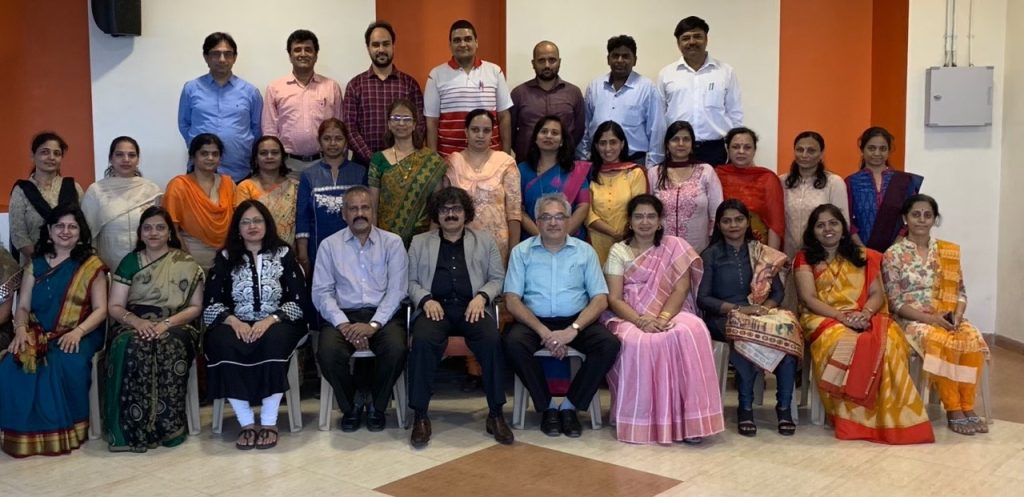
Topics of Research undertaken:
| 1 | Models for making e-commerce and M-commerce ubiquitous and pervasive to improve National productivity in India |
| 2 | Re- energizing E-governance Practices by Integrating Mobile Technology Platform |
| 3 | Forecasting cloud computing life cycle |
| 4 | Information Communication Technologies for Entrepreneurship Incubation/ Startup Projects |
| 5 | Software engineering challenges for synchronizing enterprise resource planning and business intelligence |
| 6 | Reinventing Brick and Mortar Professional Education Directorate to ICT Enabled, Database Centered Professional Education Management Enterprise |
| 7 | Investigating Big Data Analytics in Indian Industries for Building Efficiencies |
| 8 | Transcending Information Technology Enterprises in India to Evolve as Total Solution Providers |
| 9 | Investigating Efficacy of Graphical User Interface in Indian E-Governance and M-Governance Projects |
| 10 | Investigation of Mass Customisation technique in Indian Consumer Electronic Sector |
| 11 | Forecasting and Modeling Automation in Indian IT Service Industry |
| 12 | Predicting Futuristic Quality Movements in Indian Manufacturing. |
| 13 | Modeling Futuristic E-governance Practices Leveraging Deep Learning Techniques. |
| 14 | Modeling IT Infrastructure for Construction Industries to Build Velocity, Agility and Intelligence |
| 15 | Forecasting computational paradigm on advent of quantum computing and it’s effect on business processes |
| 16 | Blockchain Technology for building Efficiency and Velocity in Indian Judicial System |
| 17 | Capacity and Throughput Optimization of MIMO for effective communication network |
| 18 | Wireless Body Area Networks : Propagation and Antenna for UWB and MM Waves |
| 19 | Performance Enhancements of 2 tier femtocell networks |
| 20 | Configuring Efficient RF Energy Harvesting System For WSN |
| 21 | Performance evaluation and modelling of futuristic small antennas in the realm of mobile communications |
| 22 | Developing an efficient architecture and procedures for Multipath TCP in wired and wireless domain |
| 23 | “Blind Tampering Detection and Localization in Digital Images and Videos” |
| 24 | Study of Procedures for Parameter Extraction of Maximum Targets using MIMO Radar Based System |
| 25 | Re-energizing manufacturing leveraging software engineering techniques |
| 26 | Investigating the Opportunities and Challenges in E-Governance Projects by integrating Cloud Computing and Big Data Analytics |
| 27 | Content based image retrieval using deep learning |
| 28 | Intrusion Detection System using Deep Learning |
| 29 | Validation and optimization of Image Compression Algorithm |
| 30 | Hashing in digital media |
| 31 | Detection and Analysis of Defects in Fabric using Texture Properties |
| 32 | Analyzing the efficacy of machine learning techniques on climate prediction in Maharashtra region |
| 33 | Event Recognition using Machine Learning Technique |
| 34 | Leveraging Machine Learning Technology for efficacy in predicting crop yield of Marathwada Region |
| 35 | Investigating the process of making “Software Defined Network” Agile and Lean |
| 36 | Intuitive design of GUI in realm of e-commerce in India |
| 37 | Investigating ways and means of transforming IT service enterprise into a learning organization |
| 38 | Leveraging Digital Data Analytics for Framing Public Policies |
| 39 | Investigating the efficacy of AI techniques to forecast Indian Financial Markets |
| 40 | Self Organizing Cloud to Offer Efficiency for Big Data |
| 41 | Modelling Novel Framework for Next Generation Big Data Analysis |
| 42 | Modelling cloud computing integration in Indian E-governance projects |
| 43 | Title of the Proposal Augmenting Indian Agricultural Research Using Deep Learning Techniques |
| 44 | Productivity improvement in agriculture using deep learning |
| 45 | Brain Tumor Segmentation and Analysis using Deep Learning |
| 46 | Information and Communication Technologies and Data Mining |
| 47 | Investigation of IOT based an adoptive e-health solution in the realm of disaster mitigation techniques |
| 48 | Investigating and Modelling a Recommender System: A Usability Engineering Perspective |
| 49 | Investigating Efficacies of Mobile Cloud Technology in Education Sector |
| 50 | Investigation and digitization of maternal health care data for knowledge discovery |
| 51 | Semantic information extraction for handwritten devanagari script documents |
| 52 | Investigating the Efficacy of Wireless Sensor Networks in the realm of Healthcare Monitoring System |
| 53 | Design and development of Improved Semantic Enhanced Personalizer(SEP) using User Navigational Behaviour Pattern and Demographics |
| 54 | Artificial Intelligence techniques for analyzing skin diseases prevalent in Mumbai Suburbs |
| 55 | Modeling Internet of Things (IoT) Embedded Converging Technologies for Healthcare |
| 56 | Leveraging Security Enabled Conversational Artificial Intelligence to Transform Healthcare. |
| 57 | Deep Learning enabled Image Analytics Techniques for cosmetic Dermopathies(Skin Diseases) prediction in the suburban areas of Mumbai & Thane |
| 58 | Big Data Analysis for Forecasting and Modelling Epidemic Outbreak |
| 59 | Big Data Analytics for Business Intelligence |
| 60 | Optimal Task Scheduling for Efficient Resource Allocation in Cloud Computing |
| 61 | Building Accuracies in Opinion Mining using various mining strategies and techniques |
| 62 | WiMAX based communication network for smart grid application |
| 63 | Artificial Intelligence driven Reinforcement of Handoff for wireless Networks |
| 64 | Artificial Intelligence based Energy Optimization for 6G networks |
| 65 | Dynamic Resource allocation for 6G wireless Networks using Deep Learning |
| 66 | Artificial intelligence based security system for 6G wireless networks |
| 67 | Building infallible disaggregating digital commerce platform modeller around ONDC |
| 68 | AI Driven CRM services for digital commerce platforms |
| 69 | Building efficiency through Web 3.0 in Digital Commerce |
| 70 | Design and development of Improved Semantic Enhanced Personalizer(SEP) using User Navigational Behaviour Pattern and Demographics |
| 71 | Augmenting Indian Agricultural Research Using Deep Learning Techniques |
| 72 | Building Robust Blockchain Technology-Enabled Procedures in Commodity Markets using Systems Approach |
| 73 | Hybrid Actuated Deep learning model for intrusion detection to Secure the cloud computing environment |
| 74 | Architectural AI Driven Solution Building for ESG Compliance in Enterprises |
| 75 | Generative AI for Productivity Improvement in Marketing |
| 76 | Social Network Botnet Detection |
| 77 | Machihe Learning Techniques for Forecasting Disease Outbreak in the oilseed field |
| 78 | Radically Redesigning Medical Education Leveraging Ubiquitous Generative AI Techniques |
| 79 | Agentic AI for Corporate Hospitals |
| 80 | Detecting Anomalies in the Edge Computing System Using Deep Learning Techniques |
| 81 | Integrating Multimodal LLM for efficiency in Indian Judiciary |
| 82 | Multimodal Agentic AI for Indian Constitutional Benches |
| 83 | Multimodal RAG enabled SLM for building efficiencies in Automotive Manufacturing |
| 84 | Forecasting Air Quality Index(AQI) Leveraging Deep Learning Techniques within Mumbai Metropoliton Region |
| 85 | Performance Improvement for Indian Election Campaign using AI driven Approach |
| 86 | A framework for Adaptive and Intelligent Instructional Content Creation for Higher Technical Education Tutoring |
| 87 | Performance Evaluation of Conversational AI Driven Digital Commerce |
| 88 | Integrating Generative AI and Geospatial Intelligence for Carbon Footprint Assessment |
| 89 | AI ENABLED PROCESSES FOR ADDRESSING SUSTAINABILITY ISSUES |
| 90 | Agentic AI for Building Autonomous Solutions in Healthcare |
| 91 | Architectural Tweaking of Large Laguage Model for balancing the trade-off between speed,accuracy and resource consumption |
| 92 | Frugality in Building Multimodal RAG and Use Cases |
| 93 | Architecture Solution Building of Short language model for Differentiated use cases |
| 94 | Reflective AI Agents for Building Accuracies in Use Case |
| 95 | Selection of Language Models for Business Integration |
| 96 | Building Efficiencies Leveraging Agentic AI for Meteorological Predictions |
| 97 | Ways and Means of Indian Banks evolving as a Fintech Enterprises leveraging Agentic AI |
| 98 | Modeling Multimodal Agentic AI in Investment Banking |
| 99 | AI Enabled Edge Computing for Financial Market prediction |
| 100 | Modeling Agentic AI for Quick Digital Commerce |
Dean Ph. D. Program:- Dr. Seema Kolkur
Associate Dean Ph. D. Program:- Dr. Nita Mehta, Dr. Shanthi Theresa
Internal Guides: Dr. G. T. Thampi, Dr. Ashwini Kunte, Dr. Madhuri Rao, Dr. Tanuja Sarode, Dr. Archana Patankar, Dr. Maniroja Edinburgh, Dr. Arti Deshpande, Dr. Seema Kolkur, Dr. Jayant Gadge, Dr. A. B. Kulkarni, Dr. Shanthi Theresa, Dr. Bhushan Jadhav
Guides Enrolled at TSEC Research Centre: Dr. J.W. Bakal, Dr. Dhanajay Kalbande, Dr. R. R. Sedamkar, Dr. Uttam Kolekar, Dr. Alam Shaikh, Dr. Subhash Shinde. Dr. R.G. Karandikar
Number of Research Scholars Currently Pursuing (A.Y 2025-26):- 42
Number of Research Scholars awarded Ph.D. degree till date: 63